LNG Export Facilities — 12 Million Tons Each (West Coast & Gulf Of American)
Overview of the Two Proposed Facilities
General American proposes two 12-million-ton per year LNG export facilities:
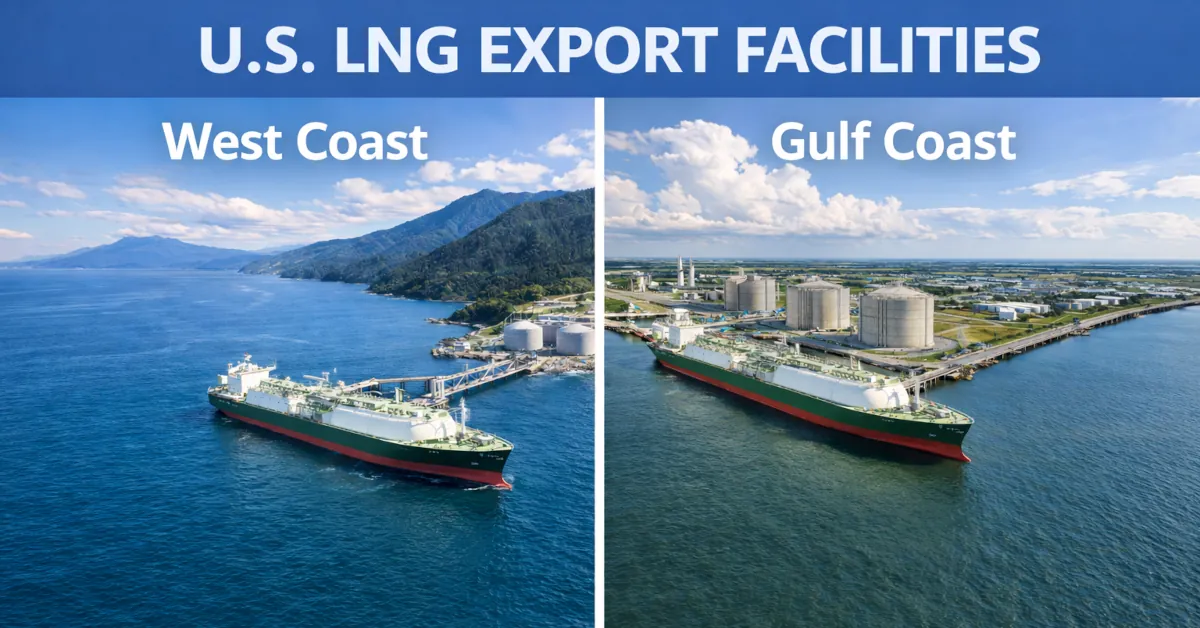
- One on the West Coast (to serve Pacific nations and accelerate U.S. exports into Asian and South American markets).
- One near Corpus Christi (to feed Europe, Africa, and the Atlantic corridor).
These two strategic locations give the United States bilateral global reach, reduce shipping distances by thousands of nautical miles, and maximize revenue for domestic natural gas producers.
Why They Are Needed
LNG demand is at an all-time high. Several geopolitical and supply-chain factors have created a global shortage:
- Europe’s pivot away from Russian gas
- Asia’s long-term energy contracts increasing
- Global coal displacement for decarbonization
- U.S. producers flaring natural gas because pipeline capacity is limited
- Global LNG prices increasing volatility due to supply constraints
Historical Data & Global Demand Link
The International Energy Agency (IEA), the U.S. Energy Information Administration (EIA), and the International Gas Union (IGU) all report strong long-term global LNG demand growth.
Here is a verified source showing global LNG demand projections through 2050, demonstrating massive expansion:
Global LNG Demand Outlook (Rystad Energy)
https://www.rystadenergy.com/news/global-lng-demand-growth-through-2050/
Why 12-Million-Ton Facilities Are the Standard
A 12-MTPA facility provides:
- Economies of scale
- Long-term reliability for buyers
- Maximum cash-flow for national reinvestment
- Feeding downstream programs like CNG, desalination, and carbon capture
LNG ships at 1/600th the volume of natural gas, making long-distance energy transport possible.
Education — Where LNG Comes From
LNG is created by:
- Extracting natural gas from the ground
- Purifying it
- Supercooling it to –260°F
- Condensing it into a liquid
If you have ever driven across America at night and seen gas flares burning above oilfields, that is the exact methane we are capturing instead of letting it burn into the atmosphere.
Education — How LNG Is Shipped (LNG Carrier Cross-section)
These carriers are engineered with:
- Spherical (Moss) or membrane cryogenic tanks
- Layers of insulation
- Dual-fuel engines
- Vent recovery systems
- Long-range capability to ship LNG 600x denser than pipeline gas